











Precision for security-relevant components
Defense Industry
WF Maschinenbau develops and manufactures forming machines for the series production of defense-related components: projectile casings for medium- and large-caliber ammunition, such as 120 mm and 155 mm calibers, cartridge cases, rocket motor housings, warheads, and bomb bodies. High-strength materials, tight tolerances, and reproducible processes are standard in this field.
The components are produced using flow forming, metal spinning, shear forming, and necking-in, resulting in near-net-shape parts made from high-strength steels, titanium, and nickel alloys. For manufacturers who need to rapidly expand their production capacity, this means reduced material usage, less machining, and stable, documented series production.
Our machines are used worldwide by manufacturers of ammunition, guided missiles, artillery systems, and external loads. As a German machine builder with over 50 years of experience in chipless metal forming, we supply individual machines and, together with selected partners, turnkey production lines for projectile casings. We develop and validate new components in advance at our own R&D center in Sendenhorst, from feasibility analysis through prototype production.
Who We Build Machines For
Our machines are designed for ammunition manufacturers, rocket and missile manufacturers, defense system integrators, and their suppliers. What they have in common: they produce rotationally symmetric metal components in series, with high requirements for strength, dimensional accuracy, and traceability. WF Maschinenbau stands for development and manufacturing in Germany, a high level of in-house production, and long-term spare parts availability. Lead times depend on machine type and design scope. Early inquiries make delivery and commissioning easier to plan.
Components Produced on WF Machines
WF Maschinenbau machines produce load-bearing, pressure-loaded, and thin-walled components for ammunition, rockets, missiles, and vehicles. The right machine and process depend on geometry, material, wall thickness, and production volume. The following overview shows typical applications.
Ammunition
- Shell bodies for medium- and large-caliber ammunition, for example 120 mm and 155 mm
- Cartridge cases
Rockets and Guided Missiles
- Rocket motor cases
- Seeker sections
- Warheads
- Rocket nozzles
Shaped Charges
- Copper cones (shaped charge liners)
Tubes
- Grenade launcher tubes
Aircraft Stores
- Bomb bodies
- Drop tanks (external fuel tanks)
Tracked Vehicles
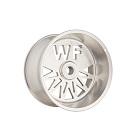
- Road wheels
Our Forming Processes for Defense Applications
Flow Forming
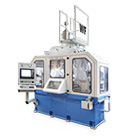
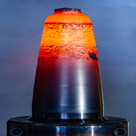
In flow forming, a preformed blank is shaped on a mandrel by several rollers. The wall becomes thinner and the component longer, with high dimensional accuracy and uniform wall thickness. The HSTR series achieves wall thickness reductions of up to 90 percent. Work hardening increases the strength of the material. Typical components include shell bodies, cartridge cases, rocket motor cases, and precision tubes. Available machines: the HSTR and VSTR flow forming series.
Metal Spinning
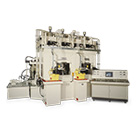
In metal spinning, rollers form a blank or preform over a rotating mandrel into a rotationally symmetric hollow component. The process is suited to conical and curved geometries such as warheads and bomb bodies, and to preforms for subsequent process steps. One example is the AHD series.
Shear Forming
In shear forming, a blank is formed in a single pass into a conical component with a precisely defined wall thickness. This produces thin-walled cones and nozzle contours with tight wall thickness tolerances, such as copper cones for shaped charges.
Necking-In
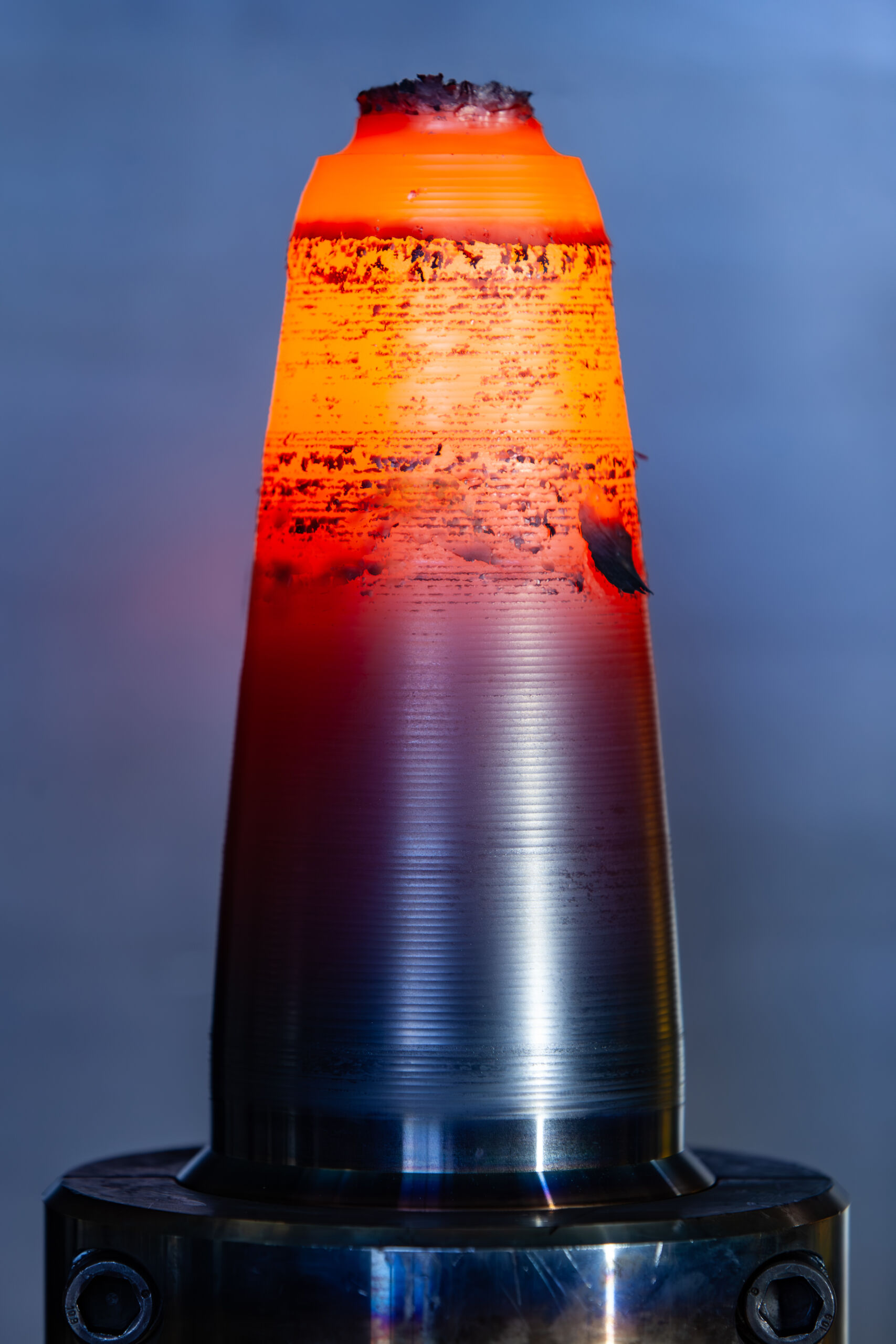
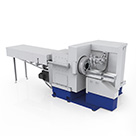
Necking-in reduces the diameter at the end of a tube or hollow component. This creates, for example, the ogive of a shell body or the neck of a pressure vessel. For high-strength materials, necking-in is performed at elevated temperature; in the industry this is also referred to as hot spinning or hot nosing. The SFM series of tube necking-in and closing machines is designed for this process.
FAQ
- Which components can be produced on WF Maschinenbau machines for the defense industry? WF Maschinenbau forming machines are used to produce ammunition bodies, shell casings, mortar tubes, rocket motor cases, seeker heads, warheads, copper liners for shaped-charge projectiles, bomb bodies and drop tanks.
- Which forming processes does WF Maschinenbau use in its machines for the defense industry? WF machines apply spinning, flow forming, projecting and necking. These processes enable near-net-shape production from high-strength steels as well as titanium and nickel alloys.
- Does WF Maschinenbau also supply complete production lines? Yes – for shell casings, WF Maschinenbau supplies complete production lines together with partner companies.
- Where are the machines built? All WF Maschinenbau machines are developed and manufactured at the company’s headquarters in Sendenhorst, Germany.
- Does WF Maschinenbau offer process development for new safety-critical components? At the WF Maschinenbau R&D Center in Sendenhorst, Germany, forming processes for new component geometries from the fields of guided weapons, ammunition and aerial stores can be developed and validated. We offer both feasibility analyses and sample production across many areas.
- Can WF Maschinenbau flow forming machines be integrated into existing production lines in the defense sector as well? WF Maschinenbau develops metal forming machines that can be integrated into automated production lines. Interfaces to handling systems, quality inspection and controls are configured on a project-specific basis.
- Does WF Maschinenbau supply forming machines for the defense industry worldwide? WF Maschinenbau supplies customers worldwide with forming machines for the defense industry. International projects are supported by a global network of representatives.
- Which quality requirements do WF Maschinenbau forming machines meet for safety-critical components?Forming machines for safety-critical components in the defense industry must ensure tight tolerance classes, complete process documentation and high reproducibility. WF Maschinenbau factors these requirements into the machine design from the outset.
- What are the delivery times for machines in the defense industry? Delivery times for machines used to produce safety-critical components are project-dependent and determined by machine type and the scope of the configuration. WF Maschinenbau recommends an early inquiry so that delivery and commissioning dates can be planned reliably.
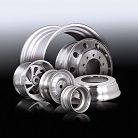
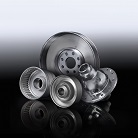
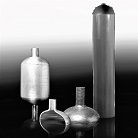
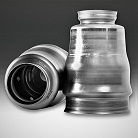
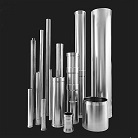
Our machines form, for example: